



Innovation in cultural experience design
Museums invest millions creating unforgettable experiences.
Their apps often stop at helping visitors get from one gallery to the next.
As cultural institutions invest heavily in exhibitions, architecture, and programming, the digital layer often remains focused on logistics rather than engagement. Visitors can easily find where the art is, but are given little support in understanding, interpreting, or connecting with it.
During field research across Abu Dhabi's cultural institutions, I observed a recurring gap between viewing art and engaging with it. Visitors moved through exhibitions with curiosity, but often lacked the tools to interpret, contextualize, and reflect on what they encountered.
This project explores how a museum app might evolve beyond information delivery to become an active participant in the visitor journey, not just guiding visitors through a space, but helping them create meaning from what they see. Using computer vision to recognize the work in front of you, biometric signals to reflect back what it stirred in you, and the voices of other visitors to widen a single reading into many, the app supports discovery before a visit, presence during it, and meaning that lasts long after it ends.
Disclaimer: This is an independent concept and is not affiliated with or endorsed by Guggenheim. All trademarks, imagery, and media belong to their respective owners and are used for contextual portfolio presentation only.
Museums invest millions creating unforgettable experiences.
Their apps often stop at helping visitors get from one gallery to the next.
As cultural institutions invest heavily in exhibitions, architecture, and programming, the digital layer often remains focused on logistics rather than engagement. Visitors can easily find where the art is, but are given little support in understanding, interpreting, or connecting with it.
During field research at Abu Dhabi's cultural institutions, I observed a recurring gap between viewing art and engaging with it. Visitors moved through exhibitions with curiosity, but often lacked the tools to interpret, contextualize, and reflect on what they encountered.
This project explores how a museum app might evolve beyond information delivery to become an active participant in the visitor journey, not just guiding visitors through a space, but helping them create meaning from what they see. Using computer vision to recognize the work in front of you, biometric signals to reflect back what it stirred in you, and the voices of other visitors to widen a single reading into many, the app supports discovery before a visit, presence during it, and meaning that lasts long after it ends.
Disclaimer: This is an independent concept and is not affiliated with or endorsed by Guggenheim. All trademarks, imagery, and media belong to their respective owners and are used for contextual portfolio presentation only.
Industry
Museum Experiences
Cultural Technology
Role
Product Designer
Project Type
Independent Concept
Target Outcomes
+400% average dwell time per artwork
+35% repeat visits among local audiences
+60% active app engagement throughout the visit
35-45% of visitors sharing at least one GAD Highlights
card on social media
First museum app globally to combine computer vision, biometric reflection, and community voices in a single visitor experience.
Improved visitor satisfaction and NPS - targeting 75-85 versus the industry benchmark of 55-65 for major cultural institutions.
Year
2026
Museums invest millions creating unforgettable experiences. Their apps often stop at helping visitors get from one gallery to the next.
As cultural institutions invest heavily in exhibitions, architecture, and programming, the digital layer often remains focused on logistics rather than engagement. Visitors can easily find where the art is, but are given little support in understanding, interpreting, or connecting with it.
During field research across Abu Dhabi's cultural institutions, I observed a recurring gap between viewing art and engaging with it. Visitors moved through exhibitions with curiosity, but often lacked the tools to interpret, contextualize, and reflect on what they encountered.
This project explores how a museum app might evolve beyond information delivery to become an active participant in the visitor journey, not just guiding visitors through a space, but helping them create meaning from what they see. Using computer vision to recognize the work in front of you, biometric signals to reflect back what it stirred in you, and the voices of other visitors to widen a single reading into many, the app supports discovery before a visit, presence during it, and meaning that lasts long after it ends.
Disclaimer: This is an independent concept and is not affiliated with or endorsed by Guggenheim. All trademarks, imagery, and media belong to their respective owners and are used for contextual portfolio presentation only.
Industry
Museum Experiences
Cultural Technology
Role
Product Designer
Project Type
Independent Concept
Target Outcomes
+400% average dwell time per artwork
+35% repeat visits among local audiences
+60% active app engagement throughout the visit
35-45% of visitors sharing at least one GAD Highlights
card on social media
First museum app globally to combine computer vision, biometric reflection, and community voices in a single visitor experience.
Improved visitor satisfaction and NPS - targeting 75-85 versus the industry benchmark of 55-65 for major cultural institutions.
Year
2026
Years ago, during my first visit to the Guggenheim in New York, I became fascinated by a different question: could technology be in service of an artwork rather than in competition with it? Could it help someone see more, feel more, without ever standing between them and the piece?
As Guggenheim Abu Dhabi prepares to open its doors, I found myself returning to that belief. Technology, used well, doesn't explain a painting away or flatten the moment into information. It can quietly widen it by helping a visitor notice what they might have missed, understand what they're looking at, and carry a piece of it with them long after they've left the room.
This project is an attempt to put that belief into practice. Art doesn't need technology to matter. But technology, done right, can help more people feel like it does.
Years ago, during my first visit to the Guggenheim in New York, I became fascinated by a different question: could technology be in service of an artwork rather than in competition with it? Could it help someone see more, feel more, without ever standing between them and the piece?
As Guggenheim Abu Dhabi prepares to open its doors, I found myself returning to that belief. Technology, used well, doesn't explain a painting away or flatten the moment into information. It can quietly widen it by helping a visitor notice what they might have missed, understand what they're looking at, and carry a piece of it with them long after they've left the room.
This project is an attempt to put that belief into practice. Art doesn't need technology to matter. But technology, done right, can help more people feel like it does.


DESIGN DIRECTION
Taking my design guidelines from Guggenheim's brand identity.
The app’s visual direction follows the identity created for Guggenheim by Pentagram. I was especially interested in two things.
01 / Line grid
Artist, exhibition title, date and location each sit in their own field. The structure does the organizing so the content doesn't have to.
02 / Typography
The interface borrows the identity's disciplined scale, spacing, and editorial rhythm. Confident headlines, generous breathing room, a clear hierarchy between what matters most and what supports it.
Video and images below sourced from Pentagram’s Guggenheim identity project.


FROM IDENTITY TO INTERFACE
Two ideas, one running through every screen.
The line grid and editorial typography from Guggenheim's identity became the foundation for every screen I designed. Three card structures across the app show this in practice: the Collection in Focus card, the Events and Tours card, and the Exhibition Discovery card.
Each one follows the same logic: a defined field for the image, a defined field for the title, a defined field for the supporting detail.
This consistency is what gives the app its sense of unity. A visitor moving from a collection highlight to a tour reminder to an exhibition listing is seeing different content inside the same disciplined language, the one borrowed directly from the brand identity, applied across every component I built.


ON THE GROUND
Field research notes from Saadiyat Island.
My aim was to understand the broader visitor experience.
Across four research stops on Saadiyat Island, including Louvre Abu Dhabi, Zayed National Museum, teamLab Phenomena, and NYU Abu Dhabi, I observed how people navigate exhibitions, engage with technology, interpret artworks, and share cultural experiences with others.
Together, these visits surfaced the gaps that shaped every layer of this app, and pointed toward ideas the research alone couldn't have predicted.

Exhibit A · Audience
Who I Spoke To
10–12 museum visitors
Solo visitors
Friends and couples
Parents visiting with children
NYU Abu Dhabi students
First-time and frequent museum-goers

Exhibit B · Methods
Research Methods
Contextual interviews
Visitor observation
Behavioral analysis
Museum walkthroughs
Comparative experience review
THE HARVEST OF RESEARCH
Four insights that grew out of the field research

Exhibit C · Voices
Visitor Voices
“I wish there was something that helped me connect the dots."
“There is so much to see that I don’t always know where to start.”
“I’d love to know what this artwork made other people think about.”
“Sometimes I leave a museum remembering how I felt more than what I saw.”

research Locations
Louvre Abu Dhabi
Zayed National Museum
teamLab Phenomena
NYU Abu Dhabi
Exhibit D · locations

People wanted help getting started
Many visitors were curious about the artworks around them but didn't always know where to begin. They were often looking for a simple way into the artwork rather than more information.
Insight 2

Insight 2
Everyone experiences a museum differently
Some visitors came alone to reflect, others came with friends, partners, or children. The same museum had to support many different types of visits.

Insight 3
People enjoy hearing different perspectives
Visitors often felt more connected to an artwork after hearing how someone else interpreted it. Different viewpoints helped make art feel more approachable.

Insight 4
Most visits ended with a camera roll
Visitors often photographed artworks throughout their visit, but once they left the museum, those images became the primary record of the experience.
The research pointed to a gap. Visitors arrived curious but without a way in. They stood in front of artworks they wanted to understand but had no tools to go deeper. And they left with a camera roll instead of a memory.
The app was designed around those three moments: before the artwork, in front of it, and after it. Each one had a problem. Each one became a layer of the design.
I designed two versions of the museum ticket. It will be on screen for about three seconds.
That's the brief. Someone opens it at the entrance, a scanner reads the code, the phone goes back in a pocket. I still wanted those three seconds to count. A small moment of excitement, a glimpse of the beauty and structure waiting inside. So who is the ticket for?
If it belongs to operations, it's a QR code with a name on it, and anything else is decoration. If it belongs to the brand, the logo moves. If it belongs to the curators, it shows the exhibition. Each is a reasonable answer, and each would win depending on which team owns the ticket inside the museum.
Once the ticket is purchased, the app introduces its core capabilities through a short onboarding. Few screens that show the visitor what is available without overwhelming them. Displaying just enough to orient before the visit begins.


PHASE 1
BEFORE THE ARTWORK
Homepage, exhibitions, and tours.
A visitor who arrives informed arrives differently. They move with more intention, notice more, and connect more easily with what they encounter. This section of the app was designed around that belief.
The homepage is structured around the visitor's state of mind on arrival meaning its built action first, then discovery. Quick actions for tickets, visit and events sit at the top for those who know what they need. Below that, the day's program grounds the visitor in the present moment with sections that communicate what is happening right now, in this museum, today. Exhibitions, tours, and the shop follow as the visitor's attention widens from the immediate to the exploratory.
Exhibition pages were designed to close the gap between reading about art and standing in front of it. Each page introduces the artists behind the work with a short biography, their practice, and a preview of the artworks on show. By the time the visitor walks into the gallery, the work is already familiar enough to invite a deeper look.
Tours offer two entry points into the museum. Guided gallery and exhibition tours for visitors who want a structured path through the collection. Architecture tours for those drawn to the building itself which goes without saying, is a work of art in its own right.


PERSONALIZED ROUTES
Generated AI routes from the visitor's intentions
Every visitor arrives with a different intention. Some come to slow down and reflect. Others want to discover something they have never seen before. Some want to feel something specific. Yet most museums offer the same starting point to everyone, a fixed tour, a map, a predetermined path that was never built for any one person.
Accessible directly from the homepage, this feature asks one question before generating anything: what brings you here today? From that answer, combined with the visitor's available time, who they are visiting with, and their interests. AI draws from the museum's digital collection, exhibition metadata, and curatorial knowledge to generate a route that feels personal rather than prescribed.

BEHIND THE EXPERIENCE
How the Guggenheim would make it work
The personalized route experience relies on more than visitor input alone. It requires the museum's collection to be structured in a way that allows artworks, artists, exhibitions, and themes to be understood beyond their basic catalog information. By enriching collection records with curatorial knowledge and interpretive metadata, the museum can create meaningful connections between what a visitor is looking for and what the collection has to offer.
Curatorial teams could enrich collection records with themes, historical context, artistic movements, emotional qualities, and interpretive metadata.

PHASE 2
ENCOUNTERING THE ARTWORK
The five layers of the artwork page
Most museum experiences stop at the label. A serial number, a QR code, a wall of text. The visitor reads, nods, and moves on, rarely pausing long enough for the artwork to leave any real impression.
This phase was designed around a different intention. Before a visitor moves on, the app gives them every reason to stay by opening multiple ways into the same work. A community of other voices. Expert interpretation. A closer look at the detail that caught their eye. A record of what their body registered while standing there.
The visual below shows how a single artwork becomes the center of the experience. Each branch is a dedicated layer, explored in full throughout the sections that follow.
THE LAYERS OF ENCOUNTER

Voices
The Shared
Perspectives
The Informed
Surface
The Seen
Experience
The Felt
Layer 01 / About
Artwork, artist, and related works
This first layer was designed to answer the most immediate questions: What am I looking at? Who created it? Why does it matter?
Rather than separating artwork information from artist information, both are presented as a single narrative. The experience is extended further through subtle AI-powered animation that gently brings the artwork to life, and by introducing related works from the museum's collection, allowing visitors to follow their curiosity instead of reaching a dead end.

Layer 02 / Voices
See the artwork through other eyes
Creating Meaning → The Shared
Museums are overwhelming by nature. Too much to see, too many people around, no natural pause built into the experience. Visitors glance at a painting, take a photo, and move to the next one. The artwork never gets the chance to land.
That's the problem Voices was designed for. How do you create a moment of stillness inside an overwhelming environment, without forcing it?
By surfacing how other visitors experienced the same work. In their own words, pinned to the exact part of the painting that moved them.
Every voice is reviewed by the museum's digital team before it appears keeping what visitors encounter considered, appropriate, and worthy of the work it surrounds.


Museum Experience Mapping
A comparative analysis of visitor engagement and cognitive retention between traditional museum pathways and enhanced "Voices" guided journeys.

Layer 03 / Perspectives
Curated critical voices, selected for each work on show
Creating Meaning → The Informed
Standing in front of an artwork, a visitor often reaches a ceiling. They have read the label. They have listened to the audio guide. They want to go deeper but they do not know where to look and searching online in the middle of a museum gallery is not the answer.
Perspectives exists for that moment. It surfaces short written responses from critics, historians, and art writers who have a specific relationship to the work or the artist giving the visitor a direct line to how someone who has spent their life looking at art sees this specific piece.
The content is not pulled from existing reviews or aggregated from the web. It is commissioned by the museum. Because exhibitions are planned twelve to eighteen months in advance, the curatorial team has time to approach a small group of writers and thinkers with each new display rotation, asking them to contribute a response written specifically for this work, in this museum, at this moment. The voices rotate with the exhibition cycle, keeping the feature current and considered.
The result is a feature that turns expert knowledge into something personal and accessible by showing not a wall of academic text, but a single, well-chosen perspective that gives the visitor a new way into the work they are standing in front of.


Layer 04 / Surface
Powered by computer vision and AI.
Point at any detail and the painting speaks.
Creating Meaning → The Seen
Watch a visitor long enough and you'll notice it, the lean. Someone gets close to a painting, drawn in by something they can't quite name. A texture, a detail, something that doesn't look like it should be there. They stay for a moment, then walk away. Not because they stopped being curious. Because there was nothing to answer the question they didn't know how to ask.
Surface lets visitors open the camera through the app and point it at any detail of the artwork. A panel slides up with a deeper look at exactly what they're seeing. The painting technique, the fabric's historical significance, the weight of a single object in the background that most people miss.
The feature is powered by computer vision that identifies specific elements within the painting, paired with content curated by the museum's team. The technology handles the recognition. The museum provides the meaning.
Surface works at the level of a single detail, meeting the visitor at the exact moment something caught their eye, and giving that moment somewhere to go.
The longer you look, the more the painting gives back.


Museum Experience Mapping
The mapping below shows where the current museum experience breaks down the moment a visitor leans in with curiosity and walks away without an answer. Surface was designed to catch exactly that moment.

Behind the Experience
How the Guggenheim would make it work
What the visitor experiences in five seconds takes weeks to prepare. But museums rarely acquire an artwork overnight. By the time a piece arrives at the Guggenheim Abu Dhabi, the curatorial team has often known about it for months.
That lead time is exactly where the preparation happens. The team maps the artwork element by element, the fabric, the technique, the figures, the objects in the background, and writes the contextual content for each one.
That content is tagged, structured, and stored in the museum's content library, ready to be surfaced the moment a visitor points their camera at something that catches their eye. Surface is a new way for their expertise to reach the visitor.
Two systems make that moment possible. Computer vision handles the recognition, identifying what the visitor is pointing at with enough precision to distinguish a brushstroke technique from a fabric weave. The museum's curated content handles the meaning, explaining why that detail exists, what it signifies, and what history sits behind it. The technology identifies the what. The curatorial team provides the why. Neither layer works without the other.
What this creates is a new channel for the museum to act as a guide. Wall labels communicate to everyone at once. Audio guides follow a predetermined path. Surface responds to the individual, triggered not by a script, but by what the visitor actually noticed. It turns the museum's curatorial expertise into something that travels with the visitor through the gallery, available the moment curiosity strikes and not a moment before.

Years ago, during my first visit to the Guggenheim in New York, I became fascinated by the idea that the museum itself could be as memorable as the artworks it contained.
As Guggenheim Abu Dhabi prepares to open its doors, I found myself returning to that question. If the building is part of experiencing art, could the companion app be part of that experience too?
This project is an attempt to answer that. A museum is part of the experience of art. Its app should be part of that experience too.
Layer 05 / Experience
Your body's encounter with the artwork, captured through wearable tech and Bluetooth beacons.
Creating Meaning → The Felt
I wanted to go further with Guggenheim Abu Dhabi.
Experience is the most intimate layer of the app, and the most ambitious.
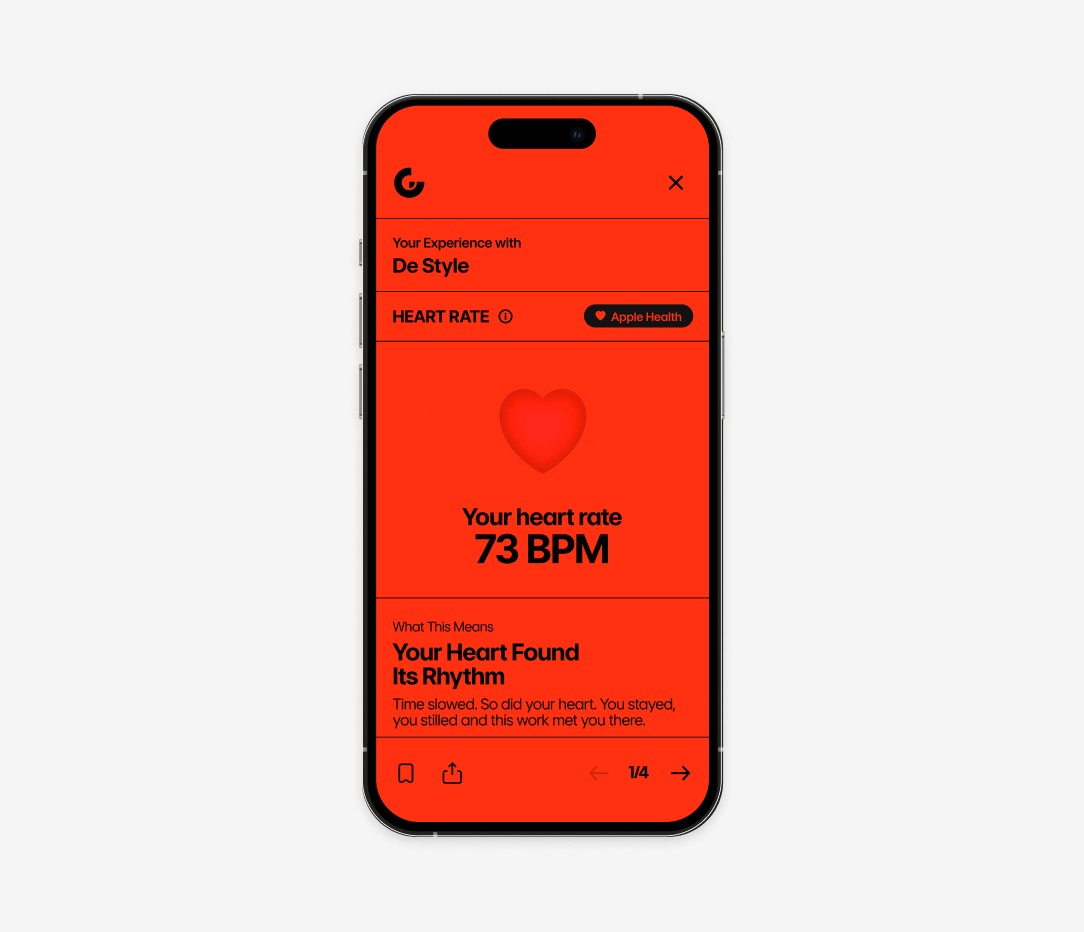
After spending at least 90 seconds with an artwork, the visitor receives a personal reflection of their own encounter. It describes how their body responded while they stood there.
The data is collected quietly through the visitor's own smart devices and wearables, with full permission granted at the start of the visit. Heart rate comes from their connected health platform. Stillness and movement come from the device's own sensors. Location comes from Bluetooth beacons already running throughout the gallery, the same infrastructure museums use to trigger audio guides.
Nothing new is installed, and nothing leaves the visitor's phone. They simply move through the museum while the app pays attention on their behalf.
When the notification arrives, it feels like the museum handing you a mirror. It shows how your body reacted to the artwork before your mind had a chance to decide.



BEHIND THE EXPERIENCE
How the Guggenheim would make it work
Experience does not require the museum to build anything new. It works with infrastructure and technology that already exists combining it in a way that has not been done before.
It begins with a scan. When a visitor opens an artwork in the app using its serial number or QR code, the exact work is confirmed with zero ambiguity. This is the foundation the experience report is built on, a deliberate act by the visitor that says: this is the work I am standing in front of.
Bluetooth beacons, already present throughout the gallery as part of the museum's standard wayfinding infrastructure, then take on a second role. They do not identify the artwork, the scan already did that. They simply confirm that the visitor is still nearby, providing the presence signal that tells the app the engagement is ongoing. Each technology does only what it is precise enough to do.
The visitor's own device does the rest. Smartphones carry accelerometers and gyroscopes as standard, the same sensors fitness apps use to detect movement and stillness. The app reads these passively to understand the quality of the visitor's presence: whether they were still, whether they shifted, whether they walked away and came back.
Heart rate is the one signal that calls for a wearable.
For visitors with a smartwatch or fitness tracker, the app connects to their device's health platform with explicit read-only permission. Visitors without a wearable still receive a report based on the remaining signals. The experience is never incomplete, only different.
Everything is processed locally on the visitor's own device. The museum never sees individual biometric data. Nothing is transmitted to external servers. The report belongs entirely to the visitor, a private record of a personal encounter that the museum made possible but does not own.

01
QR Code / Serial Number
The visitor scans the artwork label on entry. This confirms the exact work they are standing in front of, giving the system a precise anchor before any data collection begins.

02
Bluetooth Beacons
Already installed throughout the gallery for wayfinding and audio guides. The Experience feature uses the same beacons to confirm the visitor's continued presence near the artwork and measure how long they stay.

03
Wearables and Smart Devices
The visitor's own device does the sensing. The accelerometer and gyroscope built into any modern smartphone track stillness and movement. A connected smartwatch or fitness tracker captures heart rate. No additional hardware required.

04
Health API
The secure software layer that connects the visitor's health data to the app. Read-only access granted once at the start of the visit. The data never leaves the device and the museum never sees it.

PHASE 3
AFTER THE VISIT
Guggenheim Abu Dhabi Post Visit Highlights
Visits are ephemeral by nature. You move through a space, something catches your attention, something else doesn't, and then you leave. Most of what happened like the pauses, the returns, the moments of genuine stillness disappears with you.
I thought about what it would mean to give that back.
After leaving the museum, visitors receive a personal summary of their visit. A reflection, built from the signals their own devices recorded while they were inside. Time spent. Artworks that held attention. Themes that kept recurring. The biometric moments that revealed something before the visitor could articulate it themselves.
The goal is to help people understand their own experience better than they could on their own. And give them something worth sharing because it genuinely says something true about who they are and how they engage with art.
That it also happens to show what Guggenheim Abu Dhabi is capable of is not incidental. It is the point.


BEFORE THE DOORS OPEN
This project truly began with a visit to Saadiyat Island before Guggenheim Abu Dhabi had opened its doors. Standing in front of a building still under construction, I found myself thinking about what it would mean to experience art inside it, not only to see the collection, but to understand it, feel it, and carry something of it home.
Everything in this case study is an answer to that question. The five layers, the personalized routes, the biometric reflection, the visit highlights, none of it exists yet. But the intention behind all of it is real. A museum experience that treats every visitor as someone capable of forming a genuine connection with art, if given the right conditions to do so.
Guggenheim Abu Dhabi will be one of the most significant cultural institutions of its generation. This is my proposal for what its digital experience could be.


More Projects


DESIGN DIRECTION
Taking my design guidelines from Guggenheim's brand identity.
The app’s visual direction follows the identity created for Guggenheim by Pentagram. I was especially interested in two things.
01 / Line grid
Artist, exhibition title, date and location each sit in their own field. The structure does the organizing so the content doesn't have to.
02 / Typography
The interface borrows the identity's disciplined scale, spacing, and editorial rhythm. Confident headlines, generous breathing room, a clear hierarchy between what matters most and what supports it.
Video and images below sourced from Pentagram’s Guggenheim identity project.
FROM IDENTITY TO INTERFACE
Two ideas, one running through every screen.
The line grid and editorial typography from Guggenheim's identity became the foundation for every screen I designed. Three card structures across the app show this in practice: the Collection in Focus card, the Events and Tours card, and the Exhibition Discovery card.
Each one follows the same logic: a defined field for the image, a defined field for the title, a defined field for the supporting detail.
This consistency is what gives the app its sense of unity. A visitor moving from a collection highlight to a tour reminder to an exhibition listing is seeing different content inside the same disciplined language, the one borrowed directly from the brand identity, applied across every component I built.
ON THE GROUND
Field research notes from Saadiyat Island.
My aim was to understand the broader visitor experience.
Across four research stops on Saadiyat Island, including Louvre Abu Dhabi, Zayed National Museum, teamLab Phenomena, and NYU Abu Dhabi, I observed how people navigate exhibitions, engage with technology, interpret artworks, and share cultural experiences with others.
Together, these visits surfaced the gaps that shaped every layer of this app, and pointed toward ideas the research alone couldn't have predicted.
Exhibit A · Audience
Who I Spoke To
10–12 museum visitors
Solo visitors
Friends and couples
Parents visiting with children
NYU Abu Dhabi students
First-time and frequent museum-goers
Exhibit B · Methods
Research Methods
Contextual interviews
Visitor observation
Behavioral analysis
Museum walkthroughs
Comparative experience review
Exhibit C · Voices
Visitor Voices
“I wish there was something that helped me connect the dots."
“There is so much to see that I don’t always know where to start.”
“I’d love to know what this artwork made other people think about.”
“Sometimes I leave a museum remembering how I felt more than what I saw.”
THE HARVEST OF RESEARCH
Four insights that grew out of the field research

Insight 1
People wanted help getting started
Many visitors were curious about the artworks around them but didn't always know where to begin. They were often looking for a simple way into the artwork rather than more information.

Insight 2
Everyone experiences a museum differently
Some visitors came alone to reflect, others came with friends, partners, or children. The same museum had to support many different types of visits.

Insight 3
People enjoy hearing different perspectives
Visitors often felt more connected to an artwork after hearing how someone else interpreted it. Different viewpoints helped make art feel more approachable.

Insight 4
Most visits ended with a camera roll
Visitors often photographed artworks throughout their visit, but once they left the museum, those images became the primary record of the experience.
The research pointed to a gap. Visitors arrived curious but without a way in. They stood in front of artworks they wanted to understand but had no tools to go deeper. And they left with a camera roll instead of a memory.
The app was designed around those three moments: before the artwork, in front of it, and after it. Each one had a problem and each one became a layer of the design.
I designed two versions of the museum ticket. It will be on screen for about three seconds.
That's the brief. Someone opens it at the entrance, a scanner reads the code, the phone goes back in a pocket. I still wanted those three seconds to count. A small moment of excitement, a glimpse of the beauty and structure waiting inside.
So who is the ticket for?
If it belongs to operations, it's a QR code with a name on it, and anything else is decoration. If it belongs to the brand, the logo moves. If it belongs to the curators, it shows the exhibition. Each is a reasonable answer, and each would win depending on which team owns the ticket inside the museum.
Once the ticket is purchased, the app introduces its core capabilities through a short onboarding. Few screens that show the visitor what is available without overwhelming them. Displaying just enough to orient before the visit begins.
PHASE 1
BEFORE THE ARTWORK
Homepage, exhibitions, and tours.
A visitor who arrives informed arrives differently. They move with more intention, notice more, and connect more easily with what they encounter. This section of the app was designed around that belief.
The homepage is structured around the visitor's state of mind on arrival meaning its built action first, then discovery. Quick actions for tickets, visit and events sit at the top for those who know what they need. Below that, the day's program grounds the visitor in the present moment with sections that communicate what is happening right now, in this museum, today. Exhibitions, tours, and the shop follow as the visitor's attention widens from the immediate to the exploratory.
Exhibition pages were designed to close the gap between reading about art and standing in front of it. Each page introduces the artists behind the work with a short biography, their practice, and a preview of the artworks on show. By the time the visitor walks into the gallery, the work is already familiar enough to invite a deeper look.
Tours offer two entry points into the museum. Guided gallery and exhibition tours for visitors who want a structured path through the collection. Architecture tours for those drawn to the building itself which goes without saying, is a work of art in its own right.
PERSONALIZED ROUTES
Generated AI routes from your intentions, not a template
Every visitor arrives with a different intention. Some come to slow down and reflect. Others want to discover something they have never seen before. Some want to feel something specific. Yet most museums offer the same starting point to everyone, a fixed tour, a map, a predetermined path that was never built for any one person.
Accessible directly from the homepage, this feature asks one question before generating anything: what brings you here today? From that answer, combined with the visitor's available time, who they are visiting with, and their interests. AI draws from the museum's digital collection, exhibition metadata, and curatorial knowledge to generate a route that feels personal rather than prescribed.
BEHIND THE EXPERIENCE
How the Guggenheim would make it work
The personalized route experience relies on more than visitor input alone. It requires the museum's collection to be structured in a way that allows artworks, artists, exhibitions, and themes to be understood beyond their basic catalog information. By enriching collection records with curatorial knowledge and interpretive metadata, the museum can create meaningful connections between what a visitor is looking for and what the collection has to offer.
Curatorial teams could enrich collection records with themes, historical context, artistic movements, emotional qualities, and interpretive metadata.
PHASE 2
ENCOUNTERING THE ARTWORK
About, Voices, Perspectives, Surface, Experience
Most museum experiences stop at the label. A serial number, a QR code, a wall of text. The visitor reads, nods, and moves on, rarely pausing long enough for the artwork to leave any real impression.
This phase was designed around a different intention. Before a visitor moves on, the app gives them every reason to stay by opening multiple ways into the same work. A community of other voices. Expert interpretation. A closer look at the detail that caught their eye. A record of what their body registered while standing there.
The visual below shows how a single artwork becomes the center of the experience. Each branch is a dedicated layer, explored in full throughout the sections that follow.
THE LAYERS OF ENCOUNTER
Voices
The Shared
Perspectives
The Informed
Surface
The Seen
Experience
The Felt
Layer 01 / About
Artwork, artist, and related works from the collection
This first layer was designed to answer the most immediate questions: What am I looking at? Who created it? Why does it matter?
Rather than separating artwork information from artist information, both are presented as a single narrative. The experience is extended further through subtle AI-powered animation that gently brings the artwork to life, and by introducing related works from the museum's collection, allowing visitors to follow their curiosity instead of reaching a dead end.
Layer 02 / Voices
See the artwork through other eyes
Creating Meaning → The Shared
Museums are overwhelming by nature. Too much to see, too many people around, no natural pause built into the experience. Visitors glance at a painting, take a photo, and move to the next one. The artwork never gets the chance to land.
That's the problem Voices was designed for. How do you create a moment of stillness inside an overwhelming environment, without forcing it?
By surfacing how other visitors experienced the same work. In their own words, pinned to the exact part of the painting that moved them.
Every voice is reviewed by the museum's digital team before it appears keeping what visitors encounter considered, appropriate, and worthy of the work it surrounds.
Museum Experience Mapping
A comparative analysis of visitor engagement and cognitive retention between traditional museum pathways and enhanced "Voices" guided journeys.
Layer 03 / Perspectives
What art critics and historians saw in this work, curated by the museum
Creating Meaning → The Informed
Standing in front of an artwork, a visitor often reaches a ceiling. They have read the label. They have listened to the audio guide. They want to go deeper but they do not know where to look and searching online in the middle of a museum gallery is not the answer.
Perspectives exists for that moment. It surfaces short written responses from critics, historians, and art writers who have a specific relationship to the work or the artist giving the visitor a direct line to how someone who has spent their life looking at art sees this specific piece.
The content is not pulled from existing reviews or aggregated from the web. It is commissioned by the museum. Because exhibitions are planned twelve to eighteen months in advance, the curatorial team has time to approach a small group of writers and thinkers with each new display rotation, asking them to contribute a response written specifically for this work, in this museum, at this moment. The voices rotate with the exhibition cycle, keeping the feature current and considered.
The result is a feature that turns expert knowledge into something personal and accessible by showing not a wall of academic text, but a single, well-chosen perspective that gives the visitor a new way into the work they are standing in front of.
Layer 04 / Surface
Powered by computer vision and AI.
Point at any detail and the painting speaks.
Creating Meaning → The Seen
Watch a visitor long enough and you'll notice it, the lean. Someone gets close to a painting, drawn in by something they can't quite name. A texture, a detail, something that doesn't look like it should be there. They stay for a moment, then walk away. Not because they stopped being curious. Because there was nothing to answer the question they didn't know how to ask.
Surface lets visitors open the camera through the app and point it at any detail of the artwork. A panel slides up with a deeper look at exactly what they're seeing. The painting technique, the fabric's historical significance, the weight of a single object in the background that most people miss.
The feature is powered by computer vision that identifies specific elements within the painting, paired with content curated by the museum's team. The technology handles the recognition. The museum provides the meaning.
Surface works at the level of a single detail, meeting the visitor at the exact moment something caught their eye, and giving that moment somewhere to go.
The longer you look, the more the painting gives back.
Museum Experience Mapping
The mapping below shows where the current museum experience breaks down the moment a visitor leans in with curiosity and walks away without an answer. Surface was designed to catch exactly that moment.
Behind the Experience
How the Guggenheim would make it work
What the visitor experiences in five seconds takes weeks to prepare. But museums rarely acquire an artwork overnight. By the time a piece arrives at the Guggenheim Abu Dhabi, the curatorial team has often known about it for months.
That lead time is exactly where the preparation happens. The team maps the artwork element by element, the fabric, the technique, the figures, the objects in the background, and writes the contextual content for each one.
That content is tagged, structured, and stored in the museum's content library, ready to be surfaced the moment a visitor points their camera at something that catches their eye. Surface is a new way for their expertise to reach the visitor.
Two systems make that moment possible. Computer vision handles the recognition, identifying what the visitor is pointing at with enough precision to distinguish a brushstroke technique from a fabric weave. The museum's curated content handles the meaning, explaining why that detail exists, what it signifies, and what history sits behind it. The technology identifies the what. The curatorial team provides the why. Neither layer works without the other.
What this creates is a new channel for the museum to act as a guide. Wall labels communicate to everyone at once. Audio guides follow a predetermined path. Surface responds to the individual, triggered not by a script, but by what the visitor actually noticed. It turns the museum's curatorial expertise into something that travels with the visitor through the gallery, available the moment curiosity strikes and not a moment before.
Layer 05 / Experience
Your body's encounter with the artwork, captured through wearable tech and Bluetooth beacons.
Creating Meaning → The Felt
I wanted to go further with Guggenheim Abu Dhabi.
Experience is the most intimate layer of the app, and the most ambitious.
After spending at least 90 seconds with an artwork, the visitor receives a personal reflection of their own encounter. It describes how their body responded while they stood there.
The data is collected quietly through the visitor's own smart devices and wearables, with full permission granted at the start of the visit. Heart rate comes from their connected health platform. Stillness and movement come from the device's own sensors. Location comes from Bluetooth beacons already running throughout the gallery, the same infrastructure museums use to trigger audio guides.
Nothing new is installed, and nothing leaves the visitor's phone. They simply move through the museum while the app pays attention on their behalf.
When the notification arrives, it feels like the museum handing you a mirror. It shows how your body reacted to the artwork before your mind had a chance to decide.
BEHIND THE EXPERIENCE
How the Guggenheim would make it work
Experience does not require the museum to build anything new. It works with infrastructure and technology that already exists combining it in a way that has not been done before.
It begins with a scan. When a visitor opens an artwork in the app using its serial number or QR code, the exact work is confirmed with zero ambiguity. This is the foundation the experience report is built on, a deliberate act by the visitor that says: this is the work I am standing in front of.
Bluetooth beacons, already present throughout the gallery as part of the museum's standard wayfinding infrastructure, then take on a second role. They do not identify the artwork, the scan already did that. They simply confirm that the visitor is still nearby, providing the presence signal that tells the app the engagement is ongoing. Each technology does only what it is precise enough to do.
The visitor's own device does the rest. Smartphones carry accelerometers and gyroscopes as standard, the same sensors fitness apps use to detect movement and stillness. The app reads these passively to understand the quality of the visitor's presence: whether they were still, whether they shifted, whether they walked away and came back.
Heart rate is the one signal that calls for a wearable.
For visitors with a smartwatch or fitness tracker, the app connects to their device's health platform with explicit read-only permission. Visitors without a wearable still receive a report based on the remaining signals. The experience is never incomplete, only different.
Everything is processed locally on the visitor's own device. The museum never sees individual biometric data. Nothing is transmitted to external servers. The report belongs entirely to the visitor, a private record of a personal encounter that the museum made possible but does not own.
01
QR Code / Serial Number
The visitor scans the artwork label on entry. This confirms the exact work they are standing in front of, giving the system a precise anchor before any data collection begins.
02
Bluetooth Beacons
Already installed throughout the gallery for wayfinding and audio guides. The Experience feature uses the same beacons to confirm the visitor's continued presence near the artwork and measure how long they stay.
03
Wearables and Smart Devices
The visitor's own device does the sensing. The accelerometer and gyroscope built into any modern smartphone track stillness and movement. A connected smartwatch or fitness tracker captures heart rate. No additional hardware required.
04
Health API
The secure software layer that connects the visitor's health data to the app. Read-only access granted once at the start of the visit. The data never leaves the device and the museum never sees it.
PHASE 3
AFTER THE VISIT
Guggenheim Abu Dhabi Post Visit Highlights
Visits are ephemeral by nature. You move through a space, something catches your attention, something else doesn't, and then you leave. Most of what happened like the pauses, the returns, the moments of genuine stillness disappears with you.
I thought about what it would mean to give that back.
After leaving the museum, visitors receive a personal summary of their visit. A reflection, built from the signals their own devices recorded while they were inside. Time spent. Artworks that held attention. Themes that kept recurring. The biometric moments that revealed something before the visitor could articulate it themselves.
The goal is to help people understand their own experience better than they could on their own. And give them something worth sharing because it genuinely says something true about who they are and how they engage with art.
That it also happens to show what Guggenheim Abu Dhabi is capable of is not incidental. It is the point.
BEFORE THE DOORS OPEN
This project truly began with a visit to Saadiyat Island before Guggenheim Abu Dhabi had opened its doors. Standing in front of a building still under construction, I found myself thinking about what it would mean to experience art inside it, not only to see the collection, but to understand it, feel it, and carry something of it home.
Everything in this case study is an answer to that question. The five layers, the personalized routes, the biometric reflection, the visit highlights, none of it exists yet. But the intention behind all of it is real. A museum experience that treats every visitor as someone capable of forming a genuine connection with art, if given the right conditions to do so.
Guggenheim Abu Dhabi will be one of the most significant cultural institutions of its generation. This is my proposal for what its digital experience could be.
More Projects
Innovation in cultural experience design
Years ago, during my first visit to the Guggenheim in New York, I became fascinated by a different question: could technology be in service of an artwork rather than in competition with it? Could it help someone see more, feel more, without ever standing between them and the piece?
As Guggenheim Abu Dhabi prepares to open its doors, I found myself returning to that belief. Technology, used well, doesn't explain a painting away or flatten the moment into information. It can quietly widen it by helping a visitor notice what they might have missed, understand what they're looking at, and carry a piece of it with them long after they've left the room.
This project is an attempt to put that belief into practice. Art doesn't need technology to matter. But technology, done right, can help more people feel like it does.


The app’s visual direction follows the identity created for Guggenheim by Pentagram. I was especially interested in 2 things.
01 / Line grid
Artist, exhibition title, date and location each sit in their own field. The structure does the organizing so the content doesn't have to.
02 / Typography
The interface borrows the identity's disciplined scale, spacing, and editorial rhythm. Confident headlines, generous breathing room, a clear hierarchy between what matters most and what supports it.
Video and images in this section sourced from Pentagram’s Guggenheim identity project.
DESIGN DIRECTION
FROM IDENTITY TO INTERFACE

The line grid and editorial typography from Guggenheim's identity became the foundation for every screen I designed. Three card structures across the app show this in practice: the Collection in Focus card, the Events and Tours card, and the Exhibition Discovery card.
Each one follows the same logic: a defined field for the image, a defined field for the title, a defined field for the supporting detail.
This consistency is what gives the app its sense of unity. A visitor moving from a collection highlight to a tour reminder to an exhibition listing is seeing different content inside the same disciplined language, the one borrowed directly from the brand identity, applied across every component I built.

ON THE GROUND
Field research notes from Saadiyat Island.
My aim was to understand the broader visitor experience.
Across four research stops on Saadiyat Island, including Louvre Abu Dhabi, Zayed National Museum, teamLab Phenomena, and NYU Abu Dhabi, I observed how people navigate exhibitions, engage with technology, interpret artworks, and share cultural experiences with others.
Together, these visits surfaced the gaps that shaped every layer of this app, and pointed toward ideas the research alone couldn't have predicted.

Exhibit A · Audience
Who I Spoke To
10–12 museum visitors
Solo visitors
Friends and couples
Parents visiting with children
NYU Abu Dhabi students
First-time and frequent museum-goers
Exhibit A · Audience
Who I Spoke To
10–12 museum visitors
Solo visitors
Friends and couples
Parents visiting with children
NYU Abu Dhabi students
First-time and frequent museum-goers

Exhibit B · Methods
Research Methods
Contextual interviews
Visitor observation
Behavioral analysis
Museum walkthroughs
Comparative experience review
Exhibit B · Methods
Research Methods
Contextual interviews
Visitor observation
Behavioral analysis
Museum walkthroughs
Comparative experience review

Exhibit C · Voices
Visitor Voices
“I wish there was something that helped me connect the dots."
“There is so much to see that I don’t always know where to start.”
“I’d love to know what this artwork made other people think about.”
“Sometimes I leave a museum remembering how I felt more than what I saw.”
Exhibit C · Voices
Visitor Voices
“I wish there was something that helped me connect the dots."
“There is so much to see that I don’t always know where to start.”
“I’d love to know what this artwork made other people think about.”
“Sometimes I leave a museum remembering how I felt more than what I saw.”
THE HARVEST OF RESEARCH
Four insights that grew out of the field research
Insight 1
People wanted help getting started
Many visitors were curious about the artworks around them but didn't always know where to begin. They were often looking for a simple way into the artwork.
Insight 1
People wanted help getting started
Many visitors were curious about the artworks around them but didn't always know where to begin. They were often looking for a simple way into the artwork.
Insight 2
Everyone experiences a museum differently
Some visitors came alone to reflect, others came with friends, partners, or children. The same museum had to support many different types of visits.
Insight 2
Everyone experiences a museum differently
Some visitors came alone to reflect, others came with friends, partners, or children. The same museum had to support many different types of visits.
Insight 3
People enjoy hearing different perspectives
Visitors often felt more connected to an artwork after hearing how someone else interpreted it. Different viewpoints helped make art feel more approachable.
Insight 3
People enjoy hearing different perspectives
Visitors often felt more connected to an artwork after hearing how someone else interpreted it. Different viewpoints helped make art feel more approachable.
Insight 4
Most visits ended with a camera roll
Visitors often photographed artworks throughout their visit, but once they left the museum, those images became the primary record of the experience.
Insight 4
Most visits ended with a camera roll
Visitors often photographed artworks throughout their visit, but once they left the museum, those images became the primary record of the experience.
The research pointed to a gap.
Visitors arrived curious but without a way in. They stood in front of artworks they wanted to understand but had no tools to go deeper. And they left with a camera roll instead of a memory.
The app was designed around those three moments: before the artwork, in front of it, and after it.
Each one had a problem and each one became a layer of the design.

In-app digital ticket. The visual adapts based on the artwork or exhibition, connecting the entry point to the collection from the first moment. The animated elements inside the ticket are from the motion identity created by Pentagram for the Guggenheim. Fun Fact: The black and white photograph in the background shows a traditional Emirati fort, the same vernacular architecture that Frank Gehry drew from when designing the Guggenheim Abu Dhabi.
Once the ticket is purchased, the app introduces its core capabilities through a short onboarding.
Few screens that show the visitor what is available without overwhelming them. Displaying just enough explanations to orient before the visit begins.


PHASE 1
BEFORE THE ARTWORK
Homepage, exhibitions, and tours.
A visitor who arrives informed arrives differently. They move with more intention, notice more, and connect more easily with what they encounter. This section of the app was designed around that belief.
The homepage is structured around the visitor's state of mind on arrival meaning its built action first, then discovery. Quick actions for tickets, visit and events sit at the top for those who know what they need. Below that, the day's program grounds the visitor in the present moment with sections that communicate what is happening right now, in this museum, today. Exhibitions, tours, and the shop follow as the visitor's attention widens from the immediate to the exploratory.
Exhibition pages were designed to close the gap between reading about art and standing in front of it. Each page introduces the artists behind the work with a short biography, their practice, and a preview of the artworks on show. By the time the visitor walks into the gallery, the work is already familiar enough to invite a deeper look.
Tours offer two entry points into the museum. Guided gallery and exhibition tours for visitors who want a structured path through the collection. Architecture tours for those drawn to the building itself which goes without saying, is a work of art in its own right.
PERSONALIZED ROUTES
Generated AI routes from the visitor's intentions
Every visitor arrives with a different intention. Some come to slow down and reflect. Others want to discover something they have never seen before. Some want to feel something specific. Yet most museums offer the same starting point to everyone, a fixed tour, a map, a predetermined path that was never built for any one person.
Accessible directly from the homepage, this feature asks one question before generating anything: what brings you here today? From that answer, combined with the visitor's available time, who they are visiting with, and their interests. AI draws from the museum's digital collection, exhibition metadata, and curatorial knowledge to generate a route that feels personal rather than prescribed.


BEHIND THE EXPERIENCE
How the Guggenheim would make it work
The personalized route experience relies on more than visitor input alone. It requires the museum's collection to be structured in a way that allows artworks, artists, exhibitions, and themes to be understood beyond their basic catalog information.
By enriching collection records with curatorial knowledge and interpretive metadata, the museum can create meaningful connections between what a visitor is looking for and what the collection has to offer.
Curatorial teams could enrich collection records with themes, historical context, artistic movements, emotional qualities, and interpretive metadata.

PHASE 2
ENCOUNTERING THE ARTWORK
The five layers of the artwork page
Most museum experiences stop at the label. A serial number, a QR code, a wall of text. The visitor reads, nods, and moves on, rarely pausing long enough for the artwork to leave any real impression.
This phase was designed around a different intention. Before a visitor moves on, the app gives them every reason to stay by opening multiple ways into the same work. A community of other voices. Expert interpretation. A closer look at the detail that caught their eye. A record of what their body registered while standing there.
The visual below shows how a single artwork becomes the center of the experience. Each branch is a dedicated layer, explored in full throughout the sections that follow.
THE LAYERS OF ENCOUNTER
Voices
The Shared
Perspectives
The Informed
Surface
The Seen
Experience
The Felt
Layer 01 / About
How would Guggenheim museum makes it work
This first layer was designed to answer the most immediate questions: What am I looking at? Who created it? Why does it matter?
Rather than separating artwork information from artist information, both are presented as a single narrative. The experience is extended further through subtle AI-powered animation that gently brings the artwork to life, and by introducing related works from the museum's collection, allowing visitors to follow their curiosity instead of reaching a dead end.


Layer 02 / Voices
See the artwork through other eyes
Creating Meaning → The Shared
Museums are overwhelming by nature. Too much to see, too many people around, no natural pause built into the experience. Visitors glance at a painting, take a photo, and move to the next one. The artwork never gets the chance to land.
That's the problem Voices was designed for. How do you create a moment of stillness inside an overwhelming environment, without forcing it?
By surfacing how other visitors experienced the same work. In their own words, pinned to the exact part of the painting that moved them.
Every voice is reviewed by the museum's digital team before it appears keeping what visitors encounter considered, appropriate, and worthy of the work it surrounds.

Experience Mapping
A comparative analysis of visitor engagement and cognitive retention between traditional museum pathways and enhanced "Voices" guided journeys.

Layer 03 / Perspectives
Curated critical voices, selected for each work on show
Creating Meaning → The Informed
Standing in front of an artwork, a visitor often reaches a ceiling. They have read the label. They have listened to the audio guide. They want to go deeper but they do not know where to look and searching online in the middle of a museum gallery is not the answer.
Perspectives exists for that moment. It surfaces short written responses from critics, historians, and art writers who have a specific relationship to the work or the artist giving the visitor a direct line to how someone who has spent their life looking at art sees this specific piece.
The content is not pulled from existing reviews or aggregated from the web. It is commissioned by the museum. Because exhibitions are planned twelve to eighteen months in advance, the curatorial team has time to approach a small group of writers and thinkers with each new display rotation, asking them to contribute a response written specifically for this work, in this museum, at this moment. The voices rotate with the exhibition cycle, keeping the feature current and considered.
The result is a feature that turns expert knowledge into something personal and accessible by showing not a wall of academic text, but a single, well-chosen perspective that gives the visitor a new way into the work they are standing in front of.


Layer 04 / Surface
Powered by computer vision and AI.
Point at any detail and the painting speaks.
Creating Meaning → The Seen
Watch a visitor long enough and you'll notice it, the lean. Someone gets close to a painting, drawn in by something they can't quite name. A texture, a detail, something that doesn't look like it should be there. They stay for a moment, then walk away. Not because they stopped being curious. Because there was nothing to answer the question they didn't know how to ask.
Surface lets visitors open the camera through the app and point it at any detail of the artwork. A panel slides up with a deeper look at exactly what they're seeing. The painting technique, the fabric's historical significance, the weight of a single object in the background that most people miss.
The feature is powered by computer vision that identifies specific elements within the painting, paired with content curated by the museum's team. The technology handles the recognition. The museum provides the meaning.
Surface works at the level of a single detail, meeting the visitor at the exact moment something caught their eye, and giving that moment somewhere to go.
The longer you look, the more the painting gives back.
Experience Mapping
The mapping below shows where the current museum experience breaks down the moment a visitor leans in with curiosity and walks away without an answer. Surface was designed to catch exactly that moment.
Behind the Experience
How the Guggenheim would make it work
What the visitor experiences in five seconds takes weeks to prepare. But museums rarely acquire an artwork overnight. By the time a piece arrives at the Guggenheim Abu Dhabi, the curatorial team has often known about it for months.
That lead time is exactly where the preparation happens. The team maps the artwork element by element, the fabric, the technique, the figures, the objects in the background, and writes the contextual content for each one.
That content is tagged, structured, and stored in the museum's content library, ready to be surfaced the moment a visitor points their camera at something that catches their eye. Surface is a new way for their expertise to reach the visitor.
Two systems make that moment possible. Computer vision handles the recognition, identifying what the visitor is pointing at with enough precision to distinguish a brushstroke technique from a fabric weave. The museum's curated content handles the meaning, explaining why that detail exists, what it signifies, and what history sits behind it. The technology identifies the what. The curatorial team provides the why. Neither layer works without the other.
What this creates is a new channel for the museum to act as a guide. Wall labels communicate to everyone at once. Audio guides follow a predetermined path. Surface responds to the individual, triggered not by a script, but by what the visitor actually noticed. It turns the museum's curatorial expertise into something that travels with the visitor through the gallery, available the moment curiosity strikes and not a moment before.


Layer 05 / Experience
Your body's encounter with the artwork, captured through wearable tech and Bluetooth beacons.
Creating Meaning → The Felt
I wanted to go further with Guggenheim Abu Dhabi.
Experience is the most intimate layer of the app, and the most ambitious.
After spending at least 90 seconds with an artwork, the visitor receives a personal reflection of their own encounter. It describes how their body responded while they stood there.
The data is collected quietly through the visitor's own smart devices and wearables, with full permission granted at the start of the visit. Heart rate comes from their connected health platform. Stillness and movement come from the device's own sensors. Location comes from Bluetooth beacons already running throughout the gallery, the same infrastructure museums use to trigger audio guides.
Nothing new is installed, and nothing leaves the visitor's phone. They simply move through the museum while the app pays attention on their behalf.
When the notification arrives, it feels like the museum handing you a mirror. It shows how your body reacted to the artwork before your mind had a chance to decide.
BEHIND THE EXPERIENCE
How the Guggenheim would make it work
Experience does not require the museum to build anything new. It works with infrastructure and technology that already exists combining it in a way that has not been done before.
It begins with a scan. When a visitor opens an artwork in the app using its serial number or QR code, the exact work is confirmed with zero ambiguity. This is the foundation the experience report is built on, a deliberate act by the visitor that says: this is the work I am standing in front of.
Bluetooth beacons, already present throughout the gallery as part of the museum's standard wayfinding infrastructure, then take on a second role. They do not identify the artwork, the scan already did that. They simply confirm that the visitor is still nearby, providing the presence signal that tells the app the engagement is ongoing. Each technology does only what it is precise enough to do.
The visitor's own device does the rest. Smartphones carry accelerometers and gyroscopes as standard, the same sensors fitness apps use to detect movement and stillness. The app reads these passively to understand the quality of the visitor's presence: whether they were still, whether they shifted, whether they walked away and came back.
Heart rate is the one signal that calls for a wearable.
For visitors with a smartwatch or fitness tracker, the app connects to their device's health platform with explicit read-only permission. Visitors without a wearable still receive a report based on the remaining signals. The experience is never incomplete, only different.
Everything is processed locally on the visitor's own device. The museum never sees individual biometric data. Nothing is transmitted to external servers. The report belongs entirely to the visitor, a private record of a personal encounter that the museum made possible but does not own.
01
QR Code / Serial Number
The visitor scans the artwork label on entry. This confirms the exact work they are standing in front of, giving the system a precise anchor before any data collection begins.
01
QR Code / Serial Number
The visitor scans the artwork label on entry. This confirms the exact work they are standing in front of, giving the system a precise anchor before any data collection begins.
02
Bluetooth Beacons
Already installed throughout the gallery for wayfinding and audio guides. The Experience feature uses the same beacons to confirm the visitor's continued presence near the artwork and measure how long they stay.
02
Bluetooth Beacons
Already installed throughout the gallery for wayfinding and audio guides. The Experience feature uses the same beacons to confirm the visitor's continued presence near the artwork and measure how long they stay.
03
Wearables and Smart Devices
The visitor's own device does the sensing. The accelerometer and gyroscope built into any modern smartphone track stillness and movement. A connected smartwatch or fitness tracker captures heart rate. No additional hardware required.
03
Wearables and Smart Devices
The visitor's own device does the sensing. The accelerometer and gyroscope built into any modern smartphone track stillness and movement. A connected smartwatch or fitness tracker captures heart rate. No additional hardware required.
04
Health API
The secure software layer that connects the visitor's health data to the app. Read-only access granted once at the start of the visit. The data never leaves the device and the museum never sees it.
04
Health API
The secure software layer that connects the visitor's health data to the app. Read-only access granted once at the start of the visit. The data never leaves the device and the museum never sees it.

PHASE 3
AFTER THE VISIT
Guggenheim Abu Dhabi Post Visit Highlights
Visits are ephemeral by nature. You move through a space, something catches your attention, something else doesn't, and then you leave. Most of what happened like the pauses, the returns, the moments of genuine stillness disappears with you.
I thought about what it would mean to give that back.
After leaving the museum, visitors receive a personal summary of their visit. A reflection, built from the signals their own devices recorded while they were inside. Time spent. Artworks that held attention. Themes that kept recurring. The biometric moments that revealed something before the visitor could articulate it themselves.
The goal is to help people understand their own experience better than they could on their own. And give them something worth sharing because it genuinely says something true about who they are and how they engage with art.
That it also happens to show what Guggenheim Abu Dhabi is capable of is not incidental. It is the point.
BEFORE THE DOORS OPEN
This project truly began with a visit to Saadiyat Island before Guggenheim Abu Dhabi had opened its doors. Standing in front of a building still under construction, I found myself thinking about what it would mean to experience art inside it, not only to see the collection, but to understand it, feel it, and carry something of it home.
Everything in this case study is an answer to that question. The five layers, the personalized routes, the biometric reflection, the visit highlights, none of it exists yet. But the intention behind all of it is real. A museum experience that treats every visitor as someone capable of forming a genuine connection with art, if given the right conditions to do so.
Guggenheim Abu Dhabi will be one of the most significant cultural institutions of its generation. This is my proposal for what its digital experience could be.